AI will Transform Cities. Can Cities Transform AI?
Jinhua Zhao, J. Phillip Thompson, Ross Gittell, Michael Leong, and Kevin F. Hsu
1. What defines “success” when adopting AI?
A central challenge for city leaders is understanding what artificial intelligence (AI) actually is—and how it applies to municipal use cases, regulation, and real-world impacts. In reviewing AI strategies and roadmaps across the United States and internationally, we find that most definitions focus on the technical capabilities of AI systems, such as:
-
The ability of systems to “infer from the inputs [they receive] and generate outputs that can influence physical or virtual environments based on explicit or implicit objectives" (Source: European Union and the State of California);
-
The ability of systems to “provide predictions, recommendations, insights, or decisions" (Source: City of San Jose, California);
-
The ability of systems to “demonstrate human-like behavior and perform tasks which typically require human intelligence” (Source: Government of Singapore)
While these definitions are broadly consistent across jurisdictions, they share an important limitation: they describe what AI can do, but offer little guidance on how different applications should be governed, when heightened oversight is required, or how risks scale with the scope and consequences of use.
Recent experience also shows that AI is a moving target. New capabilities emerge rapidly, and their social, economic, and institutional effects can unfold in ways that we may be able to foresee, and ways that we may not. As a result, definitions anchored solely in technical functionality provide limited insight into the societal impacts of a given AI application, such as what harms it might create.
For municipal governments, this suggests a need to think about AI not only in terms of capability, but also in terms of impact. The same underlying technology can have very different implications depending on where it is used, who it affects, and what decisions it influences. Oversight, therefore, should be calibrated to its role within public systems and its potential consequences for residents and communities, instead of the AI technology itself.
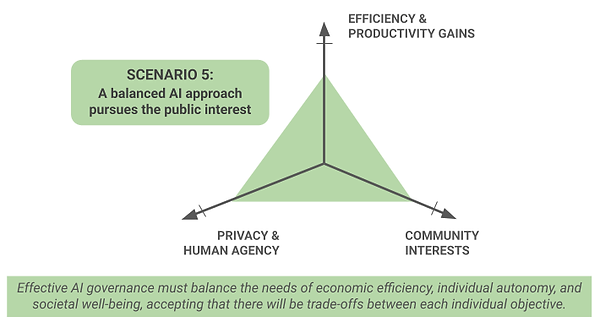
To guide these decisions, we propose that cities ground AI adoption and oversight in three core considerations that together form a practical “moral compass” for AI deployment:
A 'Moral Compass' for AI Deployment
-
Firstly, does it improve efficiency and productivity? This is a widely cited promise of AI, but one that should be tested carefully. Does it meaningfully reduce administrative burden and improve decision quality and insight, rather than simply increasing output? Does it support more strategic allocation of public sector or economic resources?
-
Secondly, does it protect privacy and preserve human agency? As AI systems increasingly shape everyday interactions and access to public services, do humans retain meaningful autonomy? Are AI-driven decisions transparent, explainable, and able to be contested?
-
Thirdly, does it advance community interests and democratic governance? Beyond individual effects, does AI serve the public good? Does it reinforce public accountability, achieve more equitable outcomes, and support participatory decision-making, rather than concentrating power or obscuring responsibility?
The figure below shows four possible sub-optimal scenarios where each of these three key characteristics are emphasized differently by AI governance efforts:

In Scenario 1, the government intervenes minimally, and AI pursues the commercial interests of private sector companies. While increases in efficiency and productivity will almost certainly materialize for the city and economy, there is little regard for how this advancement affects community interests or human agency. Governments may fall behind the curve in preventing harmful effects, and instead are caught dealing with the consequences of AI that is misaligned with social benefit.
In Scenario 2, the government may focus on enacting measures to protect individual privacy and agency, exerting a certain standard for AI usage in the public and private sector. However, without attention to distributional effects, the benefits of AI are mostly concentrated amongst those who can afford AI services, leaving behind vulnerable populations and increasing income inequality.
In Scenario 3, the government may focus on using AI to achieve what it believes to be collective goals intentionally, such as community safety or public order, but disregard concerns over individual autonomy or human rights in the process. This may lead to the use of AI by the government for increased surveillance and control, and a dangerous culture of techno-authoritarianism.
In Scenario 4, governments could in theory focus on prioritizing both privacy and human agency, as well as broad community interests, but create a burdensome regulatory regime that prevents productivity gains from emerging in the first place. While there is theoretically no ‘harm’ from this scenario, the city may become less competitive for economic investment compared to peer cities.
.png)
Finally, we propose a Scenario 5, where AI delivers on the public interest. In this scenario, governments deliberately balance three objectives: achieving productivity gains, protecting fundamental rights, and ensuring that the benefits of AI are broadly shared across society. By balancing all three objectives, governments may be unable to maximize any single objective. However, these trade-offs are important, because they make clear that principles guiding AI deployment cannot be treated as absolute rules or pursued in isolation. They emphasize that effective governance of AI as a moving target requires conscious judgment and continuous balancing across policy objectives.
What are the tools that municipal governments have to achieve these goals? And what do they need to do to arrive at a successful state of AI in the future? We believe that cities have four key advantages:
Four key levers cities have to shape AI development
-
Vast amounts of expertise in administration of public services, including public data, public records, and knowledge of specific local context and political economy. This means that governments themselves hold key knowledge on the longstanding problems that AI could fix, and crucial components for successful training and deployment of AI in their cities.
-
Direct authority over core essential domains such as housing, transportation, labor markets, and local commerce, where municipal governments have regulatory tools such as licensing, permitting, zoning, consumer protection, and fair employment standards. This places them at the ‘touch point’ between AI applications and their constituents.
-
The power to convene constituents, businesses, and civic institutions, which provides key avenues to engage the public critically on AI issues, determine the appropriate rules of engagement that address public concerns, and implement strategies that capture the value AI applications can bring to the city such as education, infrastructure, and workforce training.
-
The ability to procure large-scale contracts for digital government services, which uniquely position governments to exercise market power in setting standards for AI safety, transparency, and accountability through procurement, while also enabling them to spearhead AI applications in the public interest that the private sector may lack incentives to develop.
While most fundamental AI technology will still be developed by the private sector, we believe that through these advantages, governments have significant levers to influence not only the public sector adoption of AI, but also key private sector practices and its wider economic impacts. To exert each of these levers effectively, municipal governments need to build significant internal capacity to realize their policy goals. This includes overseeing technical and institutional risks, procurement and contracting processes, and monitoring outcomes over time. Some of these key capacities include:
Four key internal capacities cities must build
-
Technical and institutional expertise in AI, enabling governments to understand how AI systems function, assess their limitations and risks, and effectively procure, oversee, and regulate AI applications deployed by both public agencies and private-sector providers.
-
Data governance and infrastructure capacity, including the technical capability to assemble, clean, standardize, and securely manage government data, and the digital infrastructure required to support the interfaces between government data and private sector AI solutions providers.
-
Education and workforce development capacity, including the ability to design and fund reskilling and retraining programs that help public-sector workers and residents adapt to AI-driven changes in job tasks, employment structures, and skill requirements.
-
Strategic partnerships with local stakeholders, allowing collaborations with academia, labor unions, private firms, community organizations, and citizen advisory boards. This allows various stakeholders to co-develop AI governance strategies, and extend capacity via external third parties that work in the public interest.
These capacity-building efforts are not without challenges. Municipal governments face real constraints, including limited budgets, uneven technical expertise, and overlapping authority with state and federal governments. Not all cities will be able to advance across all areas at the same pace. However, acknowledging these constraints does not diminish the need for capacity. Without early investment in these capabilities, governments risk losing influence over how AI is deployed, before adequate safeguards are in place. In practice, this may result in outcomes closer to Scenarios 1 and 2 (from Figure 1), rather than the more balanced Scenario 5.
We also believe that cities should work collaboratively to preserve local flexibility in these levers in federal and state preemption of AI regulation, so that even as there may be legitimate reasons for preemption such as reducing regulatory fragmentation or establishing baseline protections, municipal governments retain flexibility to steer the course of AI towards the goals and objectives of their own city.
The following sections outline this approach in practice. Section 2 examines how governments can identify, articulate, and evaluate AI use cases, with a focus on public-sector applications and internal capacity. Section 3 then discusses how cities can invest in human, physical, and social capital to capture and share the value that AI can generate, which spans both the public and private sector.
AI will Transform Cities. Can Cities Transform AI?
Jinhua Zhao, J. Phillip Thompson, Ross Gittell, Michael Leong, and Kevin F. Hsu